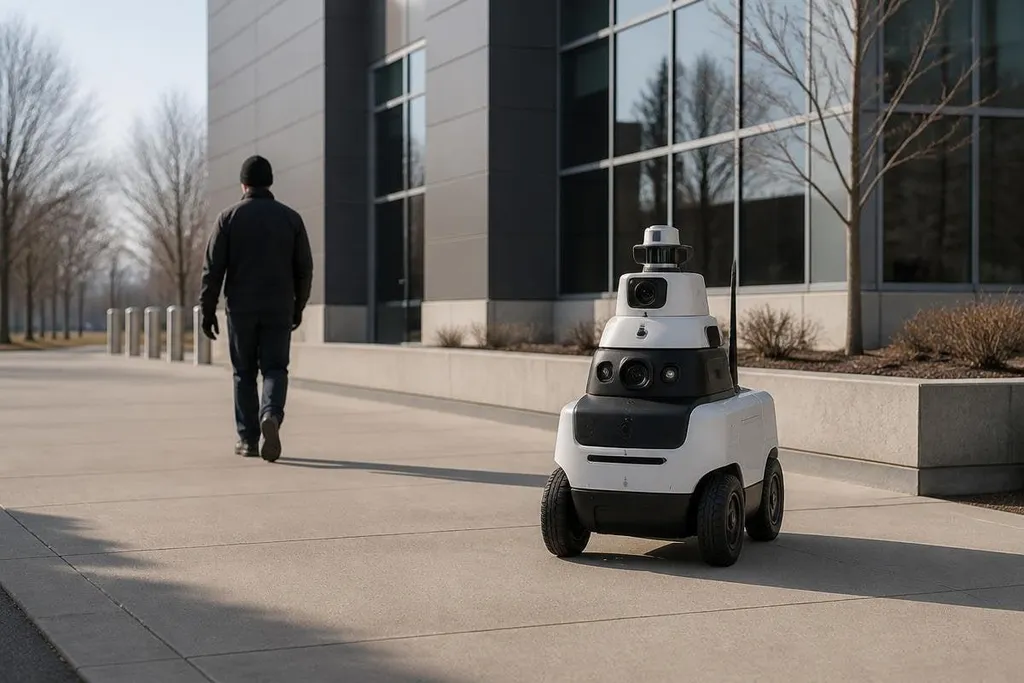
A security robot with cameras and LiDAR can patrol a site for hours, but sensors alone don't explain what they see. AI turns those sensor feeds into tasks such as spotting a person in a restricted area, following a route, or sending a useful alert.
- AI sorts routine movement from events that need human review.
- Better software still depends on clear rules, good sensor data, and human checks.
What AI adds to a patrol robot
A standard patrol robot can record video and move through mapped spaces. AI adds software that labels objects, compares new scenes with earlier ones, and checks whether movement matches the site's rules.
A camera model may identify a person, vehicle, open door, or package. LiDAR measures distance with laser pulses, so the robot can build a map and avoid fixed objects. Thermal cameras can show heat from people or equipment when visible light gives poor results.
These systems work together. The camera may spot a person, LiDAR may confirm their location, and the robot's map may show that the person is near a restricted gate. The result is a more useful alert than a video feed with no context.
Fewer false alarms, better alerts
Security teams often receive too many alerts from motion sensors. A tree moving in wind, a passing headlight, or a small animal can trigger a basic system. The software can compare the shape, speed, and location of an object before sending the event to an operator.
That filter can reduce the time spent reviewing empty corridors. It also changes what an alert contains. Instead of “motion detected,” the message may report a person near a named door, with a camera image and the robot's location.
The software can sort the event, but people must set the rules and decide what action follows. A person at a public entrance during business hours may be normal, while the same movement at a closed loading gate may need a response.
That handoff is where a patrol system becomes a management choice. Security managers can check the named robot, site, task, and human response in Robot24.com robotics coverage before judging where the system can act on its own.
Where autonomy stops
An autonomous robot may choose a route around an obstacle, but that doesn't make it a complete security service. A patrol machine still needs charging, network access, map updates, and a safe way to stop when conditions change.
Indoor maps can become wrong after a wall, shelf, or gate moves. Bright sunlight can affect cameras.
Low light can reduce image quality. LiDAR can detect an object without knowing whether it is a person, a box, or a temporary barrier.
Remote operators remain part of the system when an alert has serious consequences. A human may need to check live video, speak through the robot, contact site staff, or call emergency services. That software can sort information quickly, but it shouldn't make an unreviewed accusation or physical intervention.
Privacy adds another limit. A system that stores faces, voices, or plate numbers needs clear retention rules and access controls. The buyer should ask where data is processed, how long it stays there, and who can view it.
What to check before buying
A security robot makes sense only when its software fits the site and its daily work. Check these points before comparing patrol speed or camera resolution:
- Alert detail: Ask for a sample report that names the event, location, time, and sensor used.
- Human review: Confirm which actions need an operator and how they take control.
- Map changes: Test the robot after moving a gate, shelf, or temporary barrier.
- Data storage: Get written terms for video, audio, face data, retention, and deletion.
- Failure handling: Check what happens after a network loss, blocked route, low battery, or sensor fault.
These checks expose weak systems faster than a polished demonstration. Ask to see the robot handle a false alarm and a lost connection, not only a clean patrol run.
The next practical step
AI will make security robots more useful when it cuts review work without hiding uncertainty. For a site manager, the sensible first project is a narrow one: map one area, define a few alert rules, measure false alarms, and keep an operator in the loop.
I'd skip any system that cannot show what triggered an alert and how a person can stop or redirect the robot. The buying decision should rest on those two answers before the robot ever starts its first patrol.